
The Brand Bible. Preface: The end of the branding playbook.


End of the preface
Want the rest?
That was the preface. An introduction and eleven modules follow. Email me and I’ll tell you how to get a copy of the book.
Read it as text
The Ghost Brand
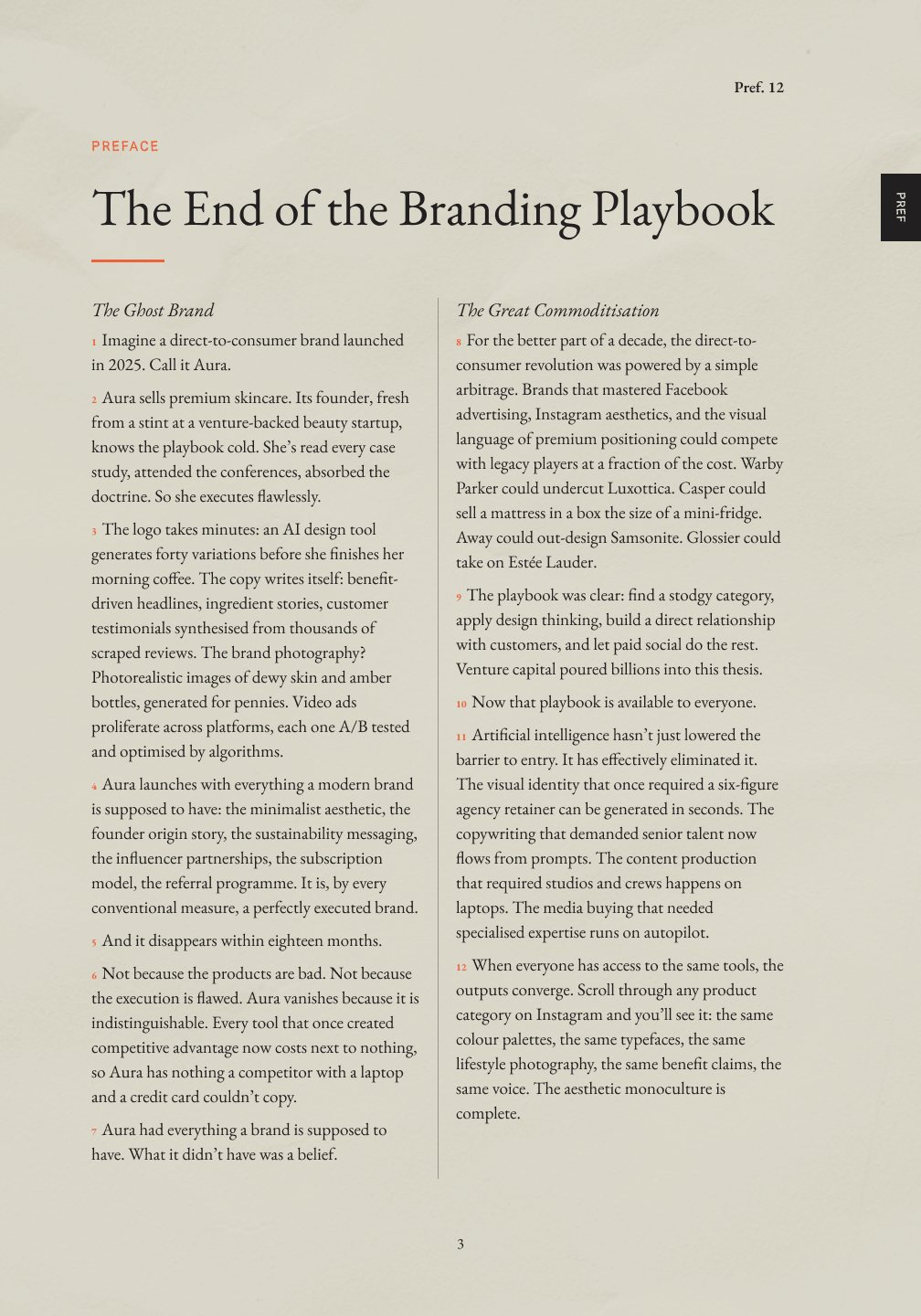
Imagine a direct-to-consumer brand launched in 2025. Call it Aura.
Aura sells premium skincare. Its founder, fresh from a stint at a venture-backed beauty startup, knows the playbook cold. She’s read every case study, attended the conferences, absorbed the doctrine. So she executes flawlessly.
The logo takes minutes: an AI design tool generates forty variations before she finishes her morning coffee. The copy writes itself: benefit-driven headlines, ingredient stories, customer testimonials synthesised from thousands of scraped reviews. The brand photography? Photorealistic images of dewy skin and amber bottles, generated for pennies. Video ads proliferate across platforms, each one A/B tested and optimised by algorithms.
Aura launches with everything a modern brand is supposed to have: the minimalist aesthetic, the founder origin story, the sustainability messaging, the influencer partnerships, the subscription model, the referral programme. It is, by every conventional measure, a perfectly executed brand.
And it disappears within eighteen months.
Not because the products are bad. Not because the execution is flawed. Aura vanishes because it is indistinguishable. Every tool that once created competitive advantage now costs next to nothing, so Aura has nothing a competitor with a laptop and a credit card couldn’t copy.
Aura had everything a brand is supposed to have. What it didn’t have was a belief.
The Great Commoditisation
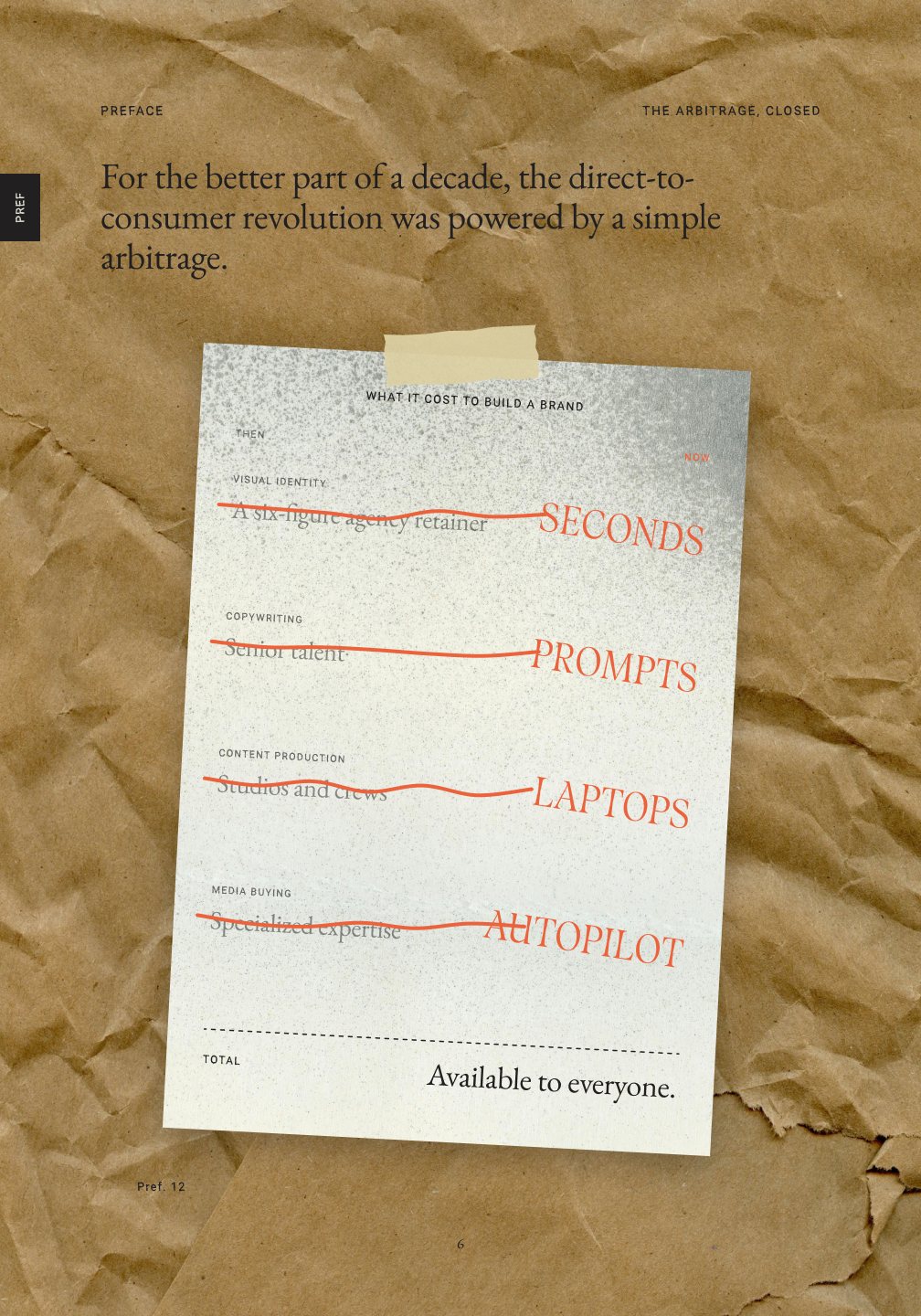
For the better part of a decade, the direct-to-consumer revolution was powered by a simple arbitrage. Brands that mastered Facebook advertising, Instagram aesthetics, and the visual language of premium positioning could compete with legacy players at a fraction of the cost. Warby Parker could undercut Luxottica. Casper could sell a mattress in a box the size of a mini-fridge. Away could out-design Samsonite. Glossier could take on Estée Lauder.
The playbook was clear: find a stodgy category, apply design thinking, build a direct relationship with customers, and let paid social do the rest. Venture capital poured billions into this thesis.
Now that playbook is available to everyone.
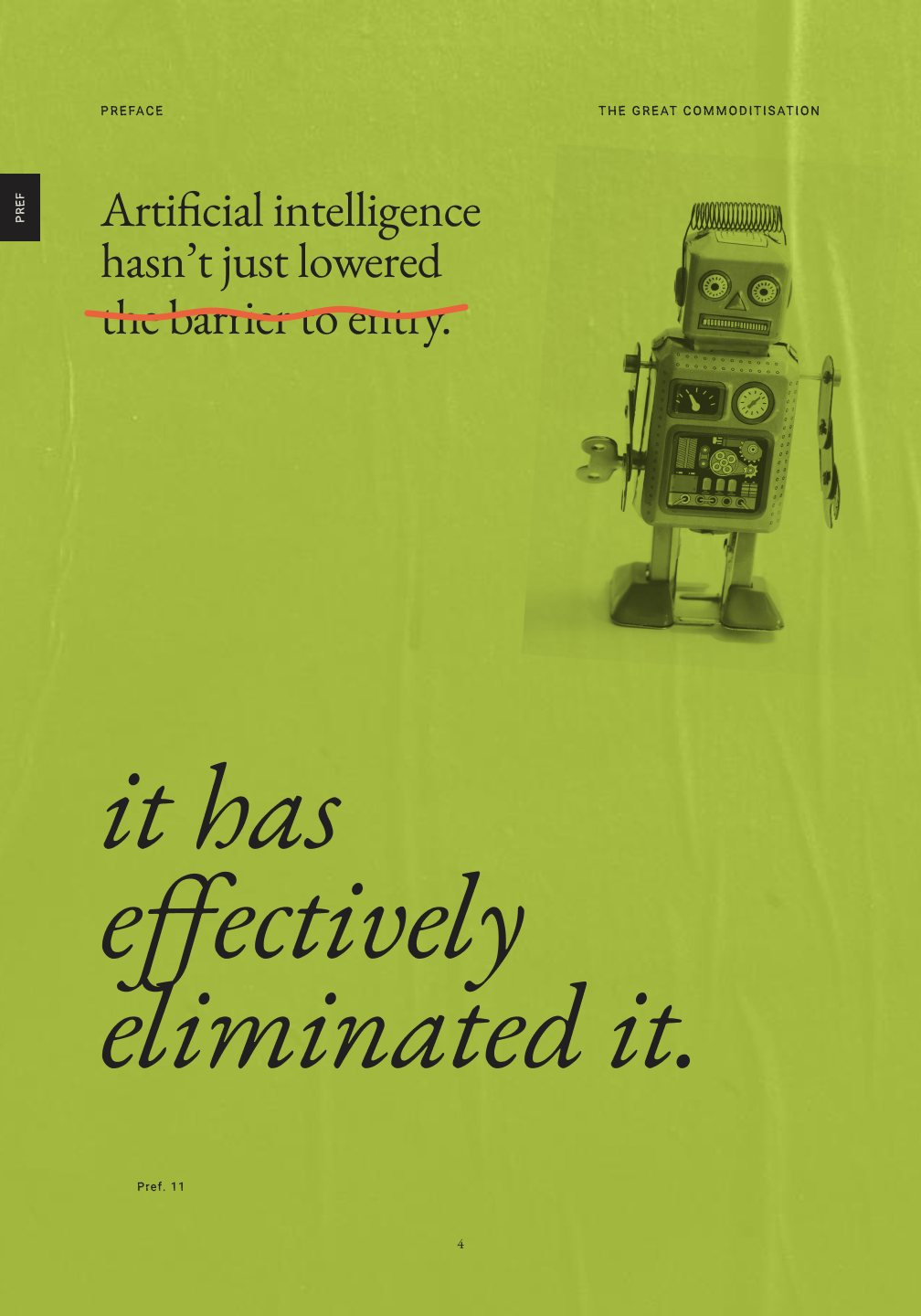
Artificial intelligence hasn’t just lowered the barrier to entry. It has effectively eliminated it. The visual identity that once required a six-figure agency retainer can be generated in seconds. The copywriting that demanded senior talent now flows from prompts. The content production that required studios and crews happens on laptops. The media buying that needed specialised expertise runs on autopilot.
Artificial intelligence hasn’t just lowered the barrier to entry. It has effectively eliminated it.
When everyone has access to the same tools, the outputs converge. Scroll through any product category on Instagram and you’ll see it: the same colour palettes, the same typefaces, the same lifestyle photography, the same benefit claims, the same voice. The aesthetic monoculture is complete.
This isn’t a temporary disruption. It’s permanent. Good branding, good writing and good assets are now cheap, and anything cheap enough for everyone stops setting anyone apart.
The Upstream Migration
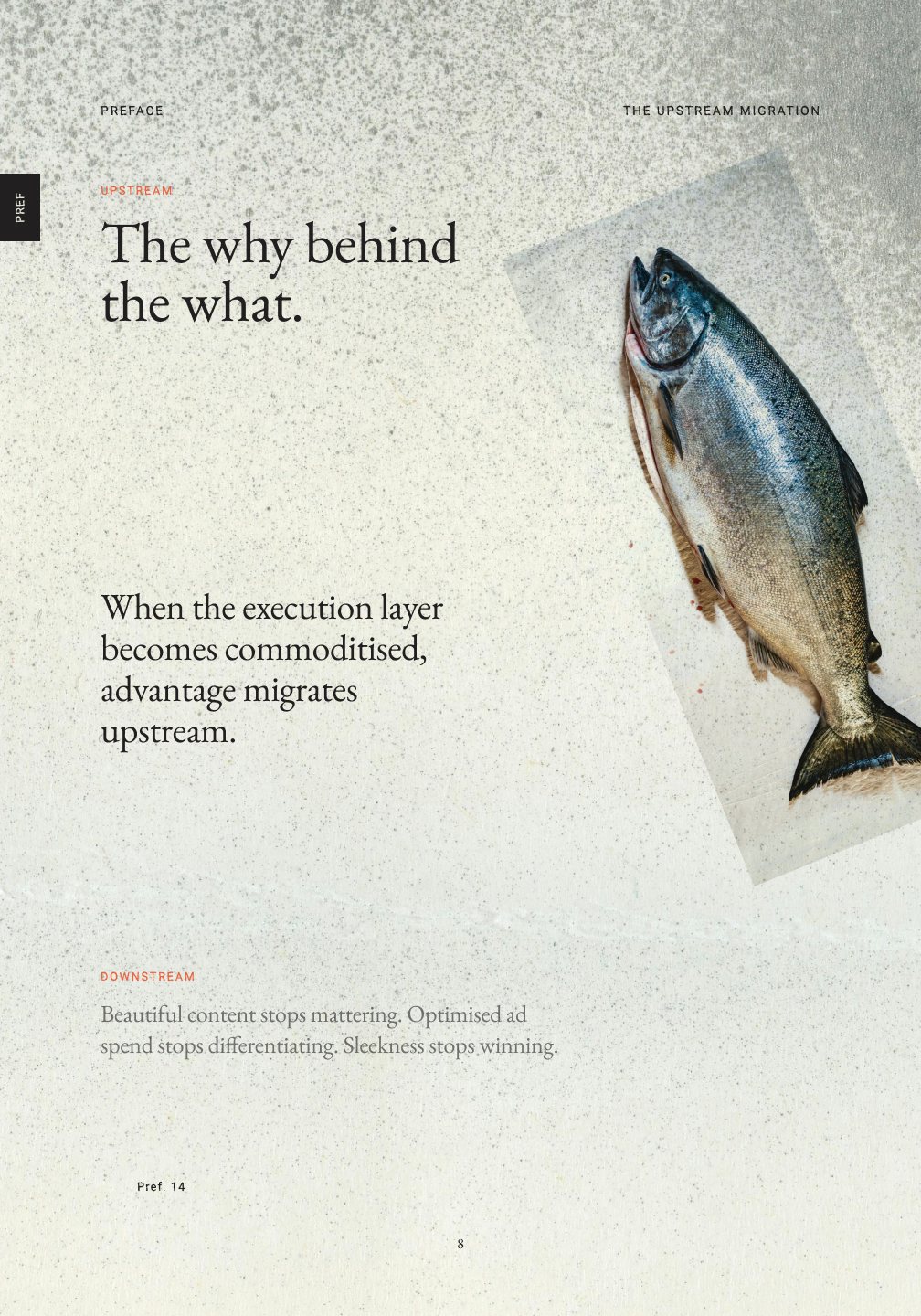
I’ve spent nearly two decades as a strategist, working across agencies in Johannesburg, Singapore, and Germany on brands ranging from Nike to Toyota to Riot Games. And in that time, I’ve watched the same pattern emerge again and again: when the execution layer becomes commoditised, advantage migrates upstream.
If anyone can produce beautiful content, beautiful content stops mattering. If anyone can optimise ad spend, optimisation stops differentiating. If anyone can build a sleek e-commerce experience, sleekness stops winning.
What remains? The decisions that precede execution. The why behind the what. The organising logic that determines which of the infinite possible executions actually gets made.
Think of it this way. AI lets you produce anything, so the question becomes how you decide what to produce. What turns infinite possibility into coherent action?
When AI can execute any direction you give it, the brand’s job is to be the direction. Not to decorate outputs, but to generate them. Not to be applied at the end of the process, but to drive the process from the beginning.
When AI can execute any direction you give it, the brand’s job is to be the direction.
That direction has to come from somewhere. In the companies that do this best, it comes from a belief system: a shared way of seeing the world that runs the whole company the way an operating system runs a computer, from product development to hiring to customer service.
Nike doesn’t just make athletic wear; its belief that everyone with a body is an athlete runs through product development, retail experience, hiring, partnerships, and advertising. Patagonia’s environmental conviction isn’t a marketing message; it shapes supply chain decisions, store locations, even which customers it would rather not have. Apple’s conviction that less is better isn’t just a design rule; it’s built into how the company designs packaging, trains retail staff and decides which products not to make.
The Case for Ideology
This book is about the most potent version of that belief system, which I call ideological architecture. It’s not the only approach. But it’s the one I’ve watched work, repeatedly, across categories as different as athletic wear and canned water.
I use the word “ideology” deliberately. Not “purpose.” Not “values.” Look at the brands with the most devoted followings: the ones where customers tattoo the logo on their bodies, where employees talk about their work like missionaries, where the line between customer and community dissolves. They operate more like belief systems than businesses. They have doctrines and heresies. Prophets and rituals. Sacred symbols and creation myths. True believers inside and outside the organisation who know instinctively what the brand would and wouldn’t do.
That is why this book uses religion as its template. Religions are the oldest brands we have. The great ones have kept their followers for centuries, across continents and languages, long after anyone who met the founder was dead. They worked out long ago what every brand is now scrambling to learn: how to make strangers feel like family, how to bring people back every week, how to hand a belief to people who will never meet the person who started it.
So each module looks at how religions solved one of those problems, and then at the brands that solved it the same way.
Ideology provides what AI cannot: a why that shapes all the whats. When you believe something deeply, every decision gets easier. You don’t need a 200-page brand book to tell employees how to respond to a customer complaint. The ideology tells them. You don’t need approval workflows for social content. The ideology guides it. You don’t need endless strategy meetings about product extensions. The ideology clarifies them.
In an age of infinite production capability, constraint becomes the competitive advantage. And ideology is the most powerful constraint there is, not because it limits what you can do but because it tells you what you should do.
In an age of infinite production capability, constraint becomes the competitive advantage.
What This Book Is
In the chapters that follow, I take apart the architecture of ideology-powered brands. Studying organisations that have done it, from religious movements to political campaigns to the most successful brands of our time, I’ve identified eleven structural elements that, built properly, turn a company from a seller of products into a generator of belief.
This is not a metaphor. These brands function like ideological movements because they are ideological movements, adapted for commercial contexts. They compete for meaning as much as for market share.
Six brands run through every chapter: Apple, CrossFit, Corteiz, Liquid Death, A24 and Wrexham AFC. Each runs on a different kind of belief. You will meet them again and again, sometimes as proof and sometimes as a warning. Where one of them misses an element, I say so, and where one has stumbled since I first wrote about it, I say what happened next. A belief that breaks is as instructive as one that holds.
Not every brand needs all eleven elements. Not every brand should pursue this path. Building an ideology-powered organisation is difficult, sometimes uncomfortable, and requires genuine conviction. You cannot fake belief.
But for founders and marketers staring at the great commoditisation, wondering how their brand survives when every competitor has the same AI tools, the same production and the same distribution, ideological architecture offers something algorithms cannot copy: a reason to exist beyond the products themselves.
The brands that will win the next decade aren’t those with the best AI-generated content. They’re the ones that know what they believe.
Good work is cheap now. Belief isn’t.